Why Not Front Air?
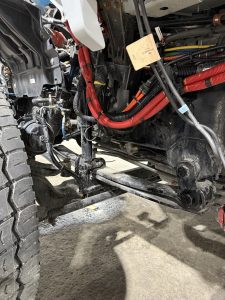
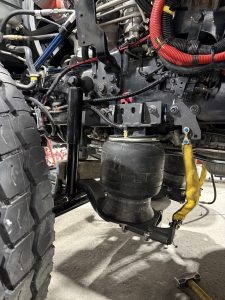
A Better Question for Waste, Recycling, Snow & Vacuum Truck Builders
In waste, recycling, snowplow and vacuum truck applications, front air suspension is often dismissed quickly — and not without reason.
The objections are well known: Durability. Complexity. Downtime risk.
And in many high‑abuse, off‑road‑dominant environments, those concerns remain valid.
But for equipment manufacturers, the more relevant question is this:
Is the front axle being asked to absorb punishment — or to protect what’s mounted on it?
✅ Where front air can make sense
For on‑road‑dominant vocational trucks, front air suspension can deliver real, application‑level benefits:
- More consistent steering geometry under variable front axle loads
- Reduced shock transfer into plow frames, packer bodies, hydraulic systems, and subframes
- Lower vibration reaching the cab, controls, and electronics
- Improved driver confidence in long, repetitive duty cycles
Vacuum truck–specific advantage:
For vacuum and hydro‑excavation trucks, front air helps manage significant front‑axle weight variation caused by hose reels, booms, water tanks, and changing fluid loads — improving steering feel, reducing component stress, and helping protect sensitive hydraulic and suction systems during transit.
In snow operations, where plow weight, ice buildup, and ride‑height variation constantly change front‑axle dynamics, controlled compliance can be an advantage — not a weakness.
In waste and recycling, where trucks endure thousands of stop‑and‑go cycles, smoother front‑axle behavior contributes to reduced fatigue and long‑term wear.
❌ Where front air does not belong
Let’s be clear — front air is not the right answer everywhere:
- Extreme off‑road access
- Repeated curb strikes without operator discipline
- Fleets prioritizing lowest‑cost survivability over performance
In those cases, mechanical or steel‑based solutions still win.
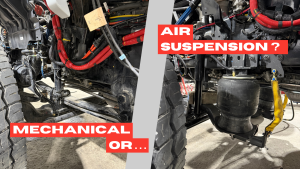
The decision OEMs should actually be making
The question isn’t “air or not air?” It’s:
Does this application benefit more from controlled compliance — or absolute rigidity?
That choice directly impacts:
- Equipment longevity
- Warranty exposure
- Operator acceptance
- Long‑term customer satisfaction
The strongest vocational platforms today are not ideological — they’re application‑specific.
Front air, applied intentionally, can be a differentiator. Applied blindly, it becomes a liability.
And knowing the difference is where smart equipment design begins.